





Used
A machine with genuine operational history. Condition varies with how it was run and how well it was maintained. The service record matters more than the age.

Home › Guides › Used Commercial Espresso Machines
Buying Guide · Used Equipment
A serviced commercial machine puts far more capability on your bench than the same outlay spent new - if you know what to inspect. This is the full checklist: the boiler questions that matter most, the group and valve tests, install requirements, and the eight questions to ask any seller.
Commercial espresso machines are built to a different standard than domestic ones. A two-group machine from an established Italian manufacturer is designed to produce hundreds of shots a day for a decade or more, with every wear part replaceable. That engineering is precisely why the used market works: a machine that has spent three years in a cafe has used a fraction of its designed life, and most of what wore out is a consumable that gets replaced during service.
Buying used typically puts a substantially more capable machine on your bench than the same outlay spent new — a serviced commercial two-group instead of an entry-level one, or a machine from a manufacturer that does not have an entry-level tier at all. For a new cafe watching capital, that difference decides what the coffee tastes like on opening day.
The risk is real but narrow, and it is almost entirely about the boiler and the service history. This checklist is how you separate the two. Start with the pre-owned commercial range.
A machine with genuine operational history. Condition varies with how it was run and how well it was maintained. The service record matters more than the age.
A used machine that has been stripped, inspected, had wear parts replaced and been tested under pressure. The work done should be documented.
Little or no commercial service. Often close to new mechanically, with cosmetic marks from being moved around. Usually the best condition-per-dollar in the used market.
Ask which of the three you are being sold, and ask for it in writing. The word "refurbished" carries no legal definition, so what actually matters is the list of parts replaced and who did the work. Every pre-owned machine we supply is inspected and serviced by our qualified technicians, with expert advice, flexible finance, and after-sales support.
Almost every serious problem in a used commercial machine traces back to the boiler, and almost every boiler problem traces back to water. Scale builds on the heating element, insulates it, makes it work harder, and eventually cracks it. Copper boilers can also corrode at the seams if a machine sat full of water, unused, for months.
What to ask and what to look for:
These are wear parts, so finding them worn is not a red flag — finding them worn and unacknowledged is. Run through:
This is where used commercial purchases most often stall, and it has nothing to do with the machine's condition. Commercial machines have specific power and water requirements, and a machine that is perfect in every other respect is useless if your site cannot supply what it needs.
Before you commit, confirm three things with our team for the specific model: the electrical supply it requires and whether your site can provide it, whether it needs a dedicated circuit, and what water supply and drainage it expects. Larger multi-group machines in particular have requirements that a standard kitchenette will not meet without work.
Also check the physical fit: bench depth, clearance above for the cup rail and lid, and access behind for servicing. Measure the doorway too — commercial machines are heavier and wider than people expect.
Send us the model and we will tell you what to check, what it needs to run at your site, and what it should have had done.
Shop Pre-Owned Commercial Get Expert AdviceA supplier who answers all eight without hesitation is a supplier worth buying from. Read our warranty terms to see what our own coverage includes.
Three machines currently in the range, and what each one illustrates about condition:
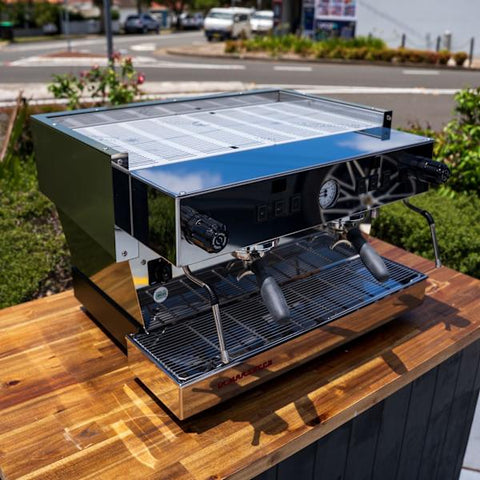
Ex-demo · 2 group · automatic volumetric
Ex-demo is the sweet spot of the used market. A machine like this has been on display or lightly used rather than run through years of cafe service, so mechanically it is close to new while sitting well below a new equivalent. This is what to look for first if your budget stretches to it.
Best for: New cafes that want a flagship platform without a flagship outlay.
View & Buy →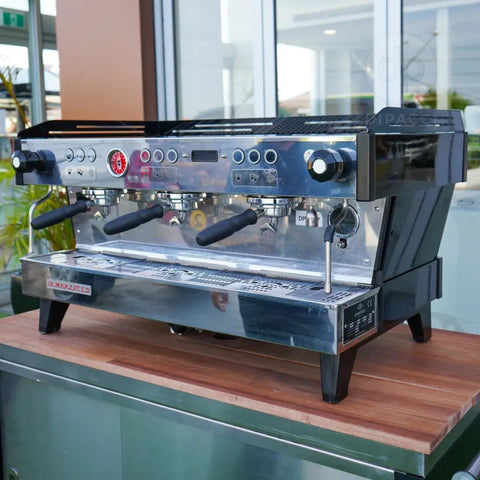
As new · 3 group · late model · automatic volumetric
A three-group in as-new condition is the machine to look at if you are opening with a real queue or adding a second bar. The reason as-new units exist is usually a venue that closed or changed direction rather than a machine that wore out, which is exactly the kind of history you want.
Best for: High-volume cafes and multi-bar venues.
View & Buy →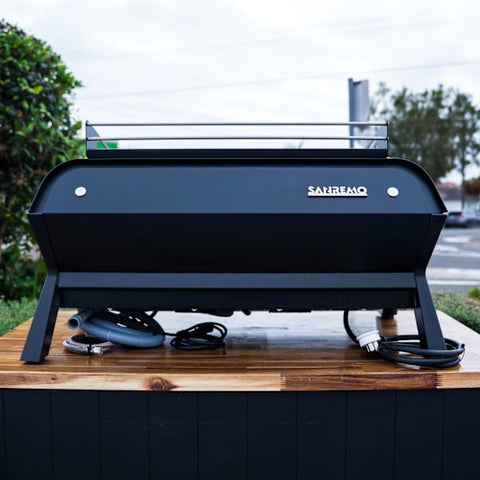
Pre-loved · 2 group · multi-boiler platform
A genuinely used machine with real cafe history is where the value sits, provided the history is good. This is the category where the checklist above earns its keep: ask about the water, ask what was replaced, and watch it hold pressure from cold before you commit.
Best for: Owners who want capability over cosmetics.
View & Buy →| Area | Good sign | Acceptable | Walk away |
|---|---|---|---|
| Water history | Filtered, records kept | Descaled recently, no records | Unfiltered hard water, never descaled |
| Boiler | Opened and inspected | Holds pressure smoothly | Pressure swings, visible crust at fittings |
| Groups | New gaskets and screens | Wear parts due, priced in | Heavy varnish, leaking under pressure |
| Three-way valve | Sharp release, firm puck | Slightly slow release | Soggy pucks, no release |
| Steam | Dry and forceful | Slight delay from cold | Wet, weak, or spluttering |
| Documentation | Itemized service record | Verbal history, demo offered | No history, no demonstration |
| Parts | Current model, parts stocked | Older but well supported | Orphaned model, no parts |
Our pre-owned inventory spans single-group through multi-group commercial machines, including brand-specific ranges: used La Marzocco, second-hand Expobar, and second-hand Wega. If you are also sourcing a grinder, the second-hand commercial grinders follow the same inspection process.
Budget beyond the machine itself. A used commercial purchase realistically needs: a water filter and its install, a grinder if one is not included, portafilters and baskets in the sizes you want to run, cleaning products from day one, and the electrical or plumbing work your site needs. Factoring those in at the start is the difference between a machine that starts earning immediately and one that sits in a box for a month.
If capital is the constraint rather than the total, flexible finance is available across the pre-owned range.
Start with the boiler and the water history: ask whether the machine ran on filtered water, when it was last descaled, and whether the boiler has been opened and inspected. Then check the group gaskets and shower screens, confirm the three-way valve releases the puck sharply, watch it hold pressure from cold, and test steam power. Finally, confirm the electrical and plumbing requirements match your site.
A used machine is sold as it came out of service, so its condition depends entirely on how it was maintained. A refurbished machine has been stripped, inspected, had wear parts replaced and been tested under pressure. Refurbished has no legal definition, so ask for the itemized list of what was replaced and who did the work rather than relying on the label.
A well-built commercial machine is designed to run for a decade or more in daily cafe service, and every significant wear part is replaceable. What ends a machine early is almost always scale from untreated water damaging the boiler and element, or a model going out of parts support. Service history and water treatment matter far more than the number of years on the machine.
It depends on the supplier, which is why it is worth asking exactly what is covered and for how long before you buy. Every pre-owned machine we supply is inspected and serviced by our qualified technicians, with expert advice, flexible finance, and after-sales support. Our warranty terms set out what is included.