





The Ultimate Guide to Automatic Office Coffee Machines for Big Workplaces
Buying Guide · Office Coffee
Automatic Coffee Machines for Large Workplaces (100+ Employees)
A large office runs on coffee, and a proper commercial setup keeps hundreds of cups flowing without bottlenecks. This guide covers what to look for at scale, the best high-capacity automatic machines, how to plan a multi-machine layout, and how quickly the system pays for itself.
100+Employees covered
200–500Cups/day at scale
Multi-machineDistributed layouts
~14 moTypical payback vs cafe runs
📋 In this guide
1. Why large offices need commercial machines
In a company with more than 100 employees, coffee is part of keeping people productive and the day running smoothly. A good automatic coffee system is an investment that affects employee satisfaction, output, and even retention — and at this scale, it needs the capacity to match.
Large offices need robust, high-capacity machines that can produce hundreds of cups a day without pausing. Commercial automatic machines are the ideal choice: they pour barista-style drinks at the touch of a button, need little training, and require less upkeep than you might expect.
- High-volume capacity — hundreds of cups a day without slowing down.
- Consistent quality — every cup tastes the same, which keeps people happy.
- Lower cost per cup — far cheaper than cafe runs or vending machines.
- Retention and productivity — good amenities help keep good staff on site.
- A professional impression — serve clients and guests properly.
- Flexible placement — distribute machines across floors or departments.
- Reliability — commercial-grade machines built to run all day.
2. What to look for at scale
Daily capacity and volume
For 100+ employees, target machines rated for at least 200–300 cups a day. Offices of 200–500+ often need multiple machines or very high-capacity models producing 400–600 cups a day combined.
Commercial durability
Large workplaces need machines built to run hard and keep going — commercial-grade components, powerful boilers, and construction that handles daily use without breaking down.
Speed and throughput
Machines need to produce drinks quickly during morning and post-lunch peaks so lines don't form. The best make a drink in 30–60 seconds and pour many in a row.
A multi-machine plan
Most large workplaces run better with several medium-to-high-capacity machines spread out rather than one giant unit. This prevents bottlenecks, cuts walking time, and gives you a backup if one machine needs service.
Easy maintenance and service
Look for accessible parts and self-cleaning cycles. Professional service contracts are important for large installations to keep downtime to a minimum.
Drink variety and smart features
A varied workforce has varied tastes, so machines should cover espresso, americano, cappuccino, latte, macchiato, flat white, and hot chocolate. Advanced machines add telemetry that tracks usage and flags maintenance before problems occur.
3. Best machines for large offices
⭐ Best for big offices
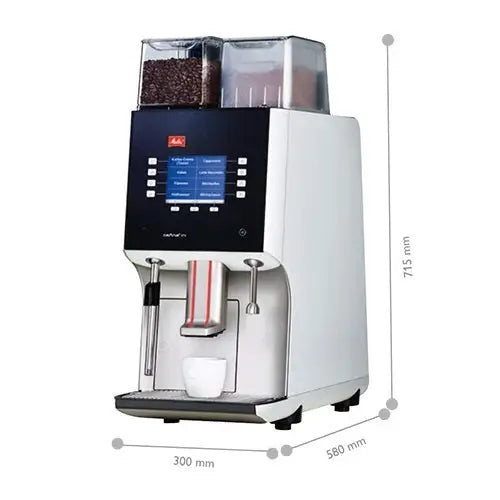
1. Melitta Cafina XT4
German-engineered · 200–300 cups/day · advanced touchscreen · 20+ drinks
The top pick for a large office. German engineering means high reliability, and the high-capacity design keeps cafe-quality coffee flowing through busy periods, comfortably handling 200–300 cups a day. A professional milk system, fast 30–45 second cycles, self-cleaning, and optional remote monitoring round it out.
Best for: corporate offices, professional services, and tech firms (100–200 people) that want the highest quality and throughput.
View the Melitta Cafina XT4 →🇸🇭 Swiss quality for heavy use
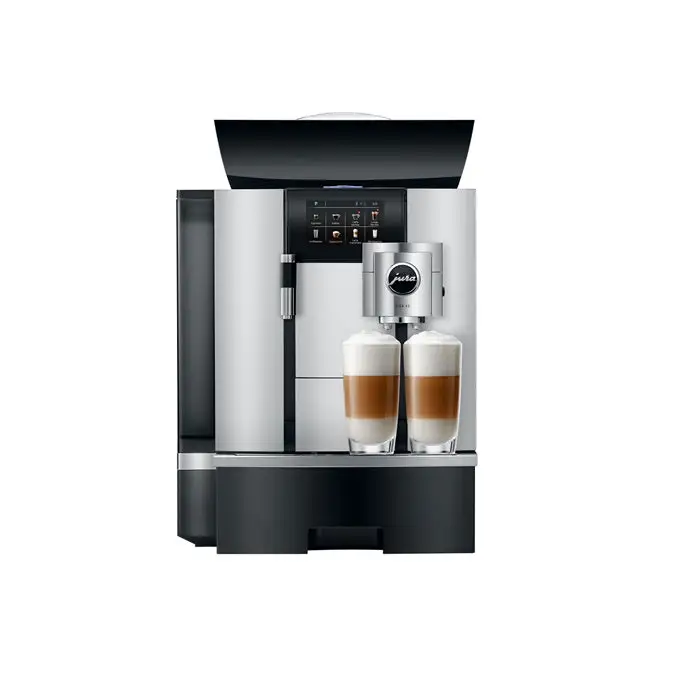
2. Jura Giga X3 G2
Swiss-built · twin bean hoppers · 150–200 cups/day · quiet operation
Swiss precision for high-use offices. Twin bean hoppers let you serve regular and decaf at once, and barista-style espresso and milk drinks come with a high-end design that suits modern workspaces. Fast heat-up, automatic cleaning cycles, and quiet operation make it easy to live with.
Best for: executive floors, high-end offices, and creative agencies (75–150 people) where coffee quality matters.
View the Jura Giga X3 G2 →💰 Best value for growing offices

3. Dr Coffee Break Big + Milk Fridge
Medium-high capacity · included milk fridge · one-touch · touchscreen
A cost-effective way for a large business to serve reliable, good coffee. This fully automatic system handles medium-to-high volume while keeping drink quality high, and the included professional milk fridge keeps fresh milk on hand for the best results.
Best for: large offices on a budget and growing firms (80–120 people) that want professional coffee without a premium price.
View the Dr Coffee Break Big →🇮🇹 Italian espresso quality
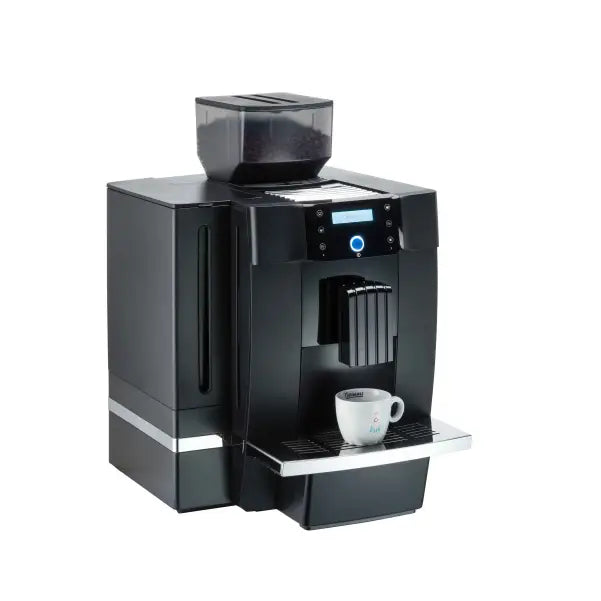
4. Carimali CA1100
Italian-built · 100–150 cups/day · customizable programs · compact
The Carimali CA1100 brings authentic Italian espresso tradition to a large office, pairing a traditional coffee approach with modern convenience. Known for reliability and consistent quality, it delivers professional-grade espresso with customizable drink programs in a space-saving footprint.
Best for: European-minded companies (60–100 people) that value coffee culture and first impressions.
View the Carimali CA1100 →🧰 Best for departmental add-ons

5. Dr Coffee H10 + Milk Fridge
Compact · one-touch · included 21L milk fridge · departmental capacity
Built for smaller groups, the H10 package is ideal for large offices deploying several machines across departments, floors, or break rooms. Distributing units this way cuts down on traffic and puts good coffee within easy reach of every team.
Best for: multi-floor offices, departmental coffee stations, executive suites, and backup units in large installations.
View the Dr Coffee H10 →Planning coffee for a large workplace?
Our team can assess your headcount, floor plan, and peak times, then design a multi-machine setup with installation and staff training.
Shop Automatic Machines Request a Consultation4. Office system vs cafe runs: the math
The economics favor an on-site system quickly, even at scale. Consider a 150-person office where a conservative 50 people each buy one cafe coffee a day: at typical cafe prices, that's roughly five thousand dollars a month in coffee runs — on the order of sixty thousand dollars a year.
A multi-machine office system flips that. After the one-time cost of the machines, ongoing spend is just beans, milk, supplies, and servicing — a small fraction of the cafe total each month. For a large office, a full system typically pays for itself in a little over a year, then keeps saving money every year after — on top of the productivity gained by keeping staff on site.
💡 Rule of thumb: if a meaningful share of your team buys coffee out daily, an on-site system almost always costs far less over the life of the machines — while improving the workday for everyone.
5. How to deploy machines across a big office
| Team size | Suggested setup | Why |
|---|---|---|
| 100–150 | One Melitta Cafina XT4, or two Jura Giga X3 G2 | Single or twin high-capacity units for one or two floors |
| 150–250 | Two Cafina XT4 + one Dr Coffee Break Big | Main units on key floors, plus a backup in a busy area |
| 250–500 | Three to five high-capacity machines | One per floor or major department for redundancy |
| 500+ | Departmental H10 units + Cafina XT4 in shared spaces | Each department served, big units in common areas |
Browse the full range of automatic coffee machines and commercial coffee machines to compare options.
6. Daily care and professional servicing
Daily (10–15 minutes per machine)
- Empty drip trays and grounds; refill water or check plumbing.
- Top up beans, wipe surfaces, and run cleaning cycles when prompted.
- Check the milk fridge and watch for any error notifications.
Weekly (30–45 minutes per machine)
- Deep-clean milk systems and remove/clean brew groups.
- Descale as scheduled, check water filters, and clean bean hoppers.
- Inspect gaskets and seals.
Professional servicing
Service contracts are important for large installations. Schedule professional service every three to six months depending on usage. Di Pacci USA offers full service plans covering preventive maintenance, repairs, parts, and technical support, alongside flexible finance and expert advice from our team. Assigning each machine to a staff owner and keeping a cleaning/maintenance log helps keep everything running smoothly.
7. Frequently asked questions
What coffee machine is best for a 150-person office?
For 150 staff, a common approach is two Melitta Cafina XT4 machines placed in different areas or on different floors. This adds redundancy, cuts congestion at peak times, and can handle 400–600 cups a day combined. Three Jura Giga X3 G2 units are another strong distributed option.
How many coffee machines does a large office need?
As a general rule, plan on one high-capacity machine (200–300 cups a day) for every 100–150 employees. Several medium units spread out often serve better than one very large unit. Factor in floor layout, peak times, and walking distance when deciding.
How much does it cost to run machines for 100+ people?
For 100–200 employees, budget for beans, milk, cleaning supplies, and upkeep each month. That is still far less than alternatives like cafe runs, which can cost several thousand dollars a month for the same number of employees.
Do these machines need special installation?
High-capacity machines perform best plumbed directly to water and drain lines, which calls for professional installation. Some models have built-in tanks but need more frequent refills in high-traffic spaces. We provide full installation, including plumbing and electrical work.
Can office machines handle the morning rush?
Yes. High-capacity machines like the Melitta Cafina XT4 brew drinks in 30–45 seconds and run continuously. The key is matching the number of machines to your headcount and placing them well to spread the load at peak times.
Should we lease or buy office coffee machines?
Both work. Buying gives full ownership and possible tax advantages; leasing spreads the cost, often includes maintenance, and makes upgrading easier. Many large installations use operating leases or all-inclusive service programs. Our team can help you weigh the options for your needs.
Ready to plan your workplace coffee program? Browse automatic coffee machines, explore finance options, or contact our team for a setup matched to your office.
- Choosing a selection results in a full page refresh.